AI Agent Cost for a Small Business: What You Really Pay
AI agent cost for a small business, worked out from list prices: hosted per-outcome fees, model tokens for a custom agent, upkeep, and when a build pays off.

On this page
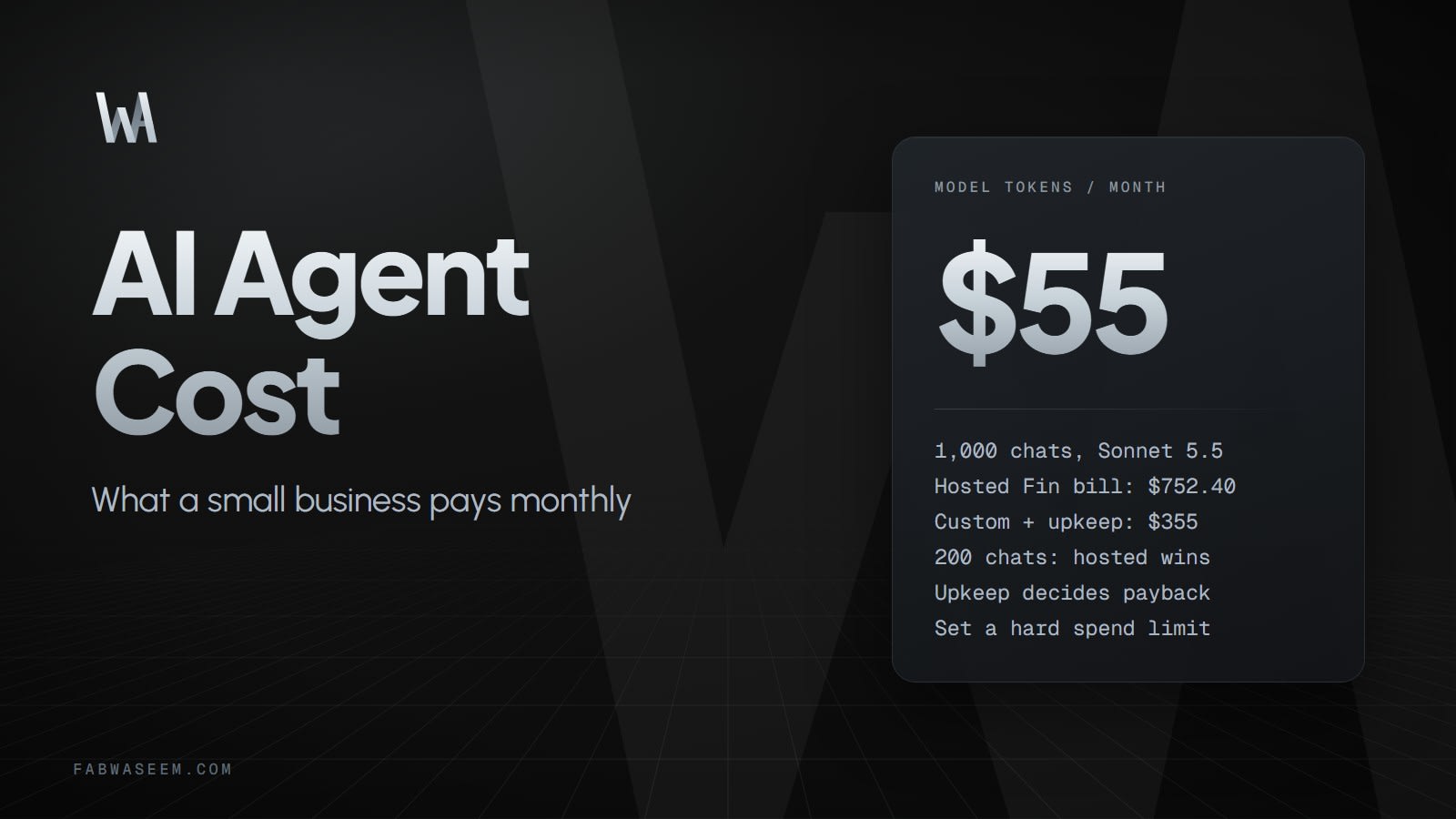
AI agent cost for a small business comes in two shapes: a hosted product that charges per resolved issue or conversation (for example $0.99 per outcome for Intercom's Fin), or a custom agent where you pay a build fee, then model tokens, hosting and upkeep. At 1,000 support conversations a month, a per-outcome product comes to about $750. A custom agent's model usage can be under $60, or about $355 with an assumed $300 for hosting, tools and maintenance, before the build fee.
That gap does not mean custom is always cheaper. The build fee and the monthly upkeep decide it, and at low volume the hosted product usually wins. This guide shows the arithmetic with list prices as published in November 2026, so you can swap in your own numbers.
What makes up AI agent cost?#
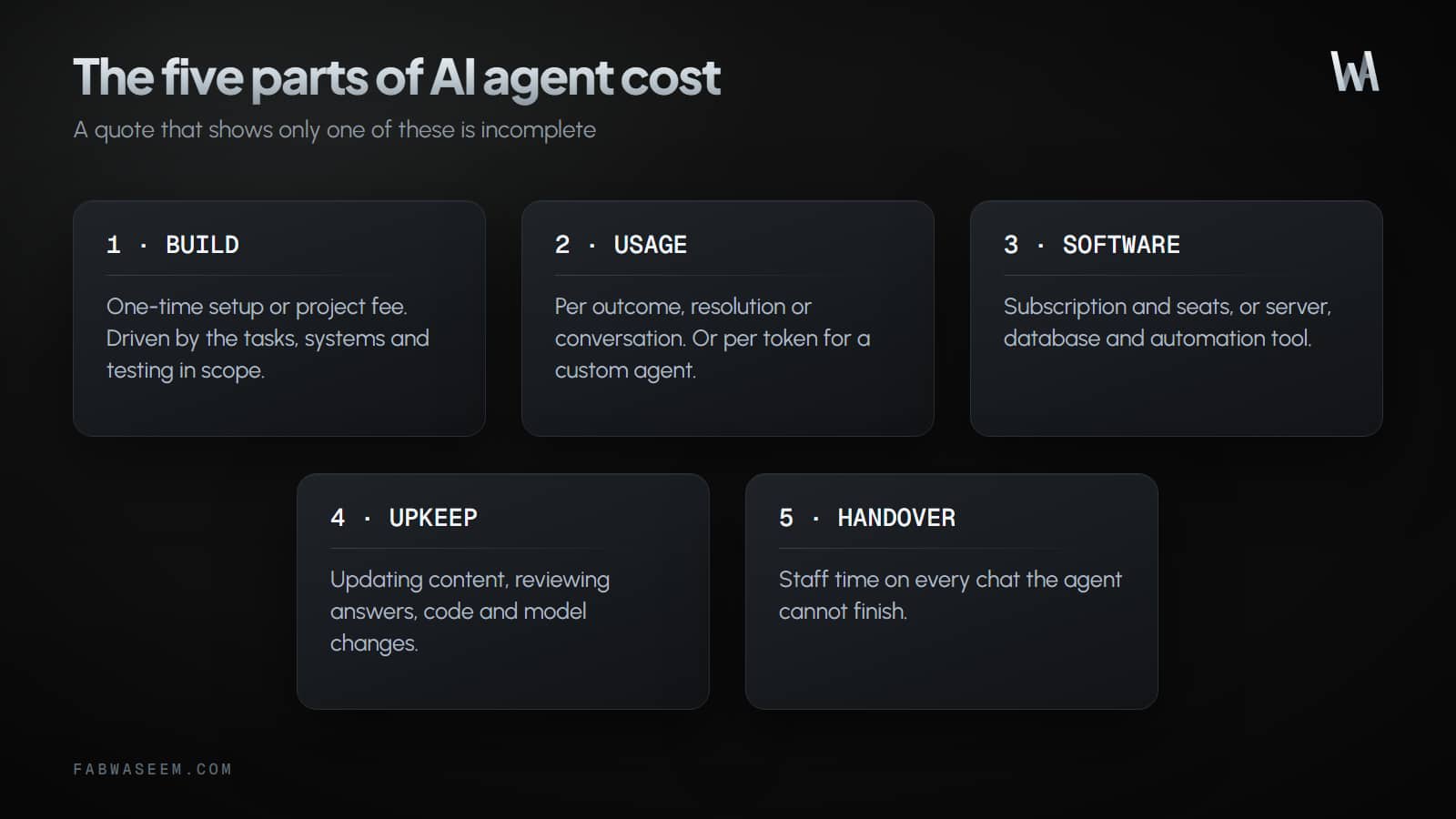
AI agent cost has five parts: the one-time build or setup, a usage charge (per outcome, per conversation or per token), the software it runs on, ongoing upkeep, and the staff time spent on whatever the agent cannot finish. A quote that shows only one of these is incomplete.
Messaging channels add their own fees. If your agent lives on WhatsApp, read the WhatsApp AI chatbot cost breakdown as well, because Meta's charges sit on top of everything below.
How much do hosted AI agents charge per month?#
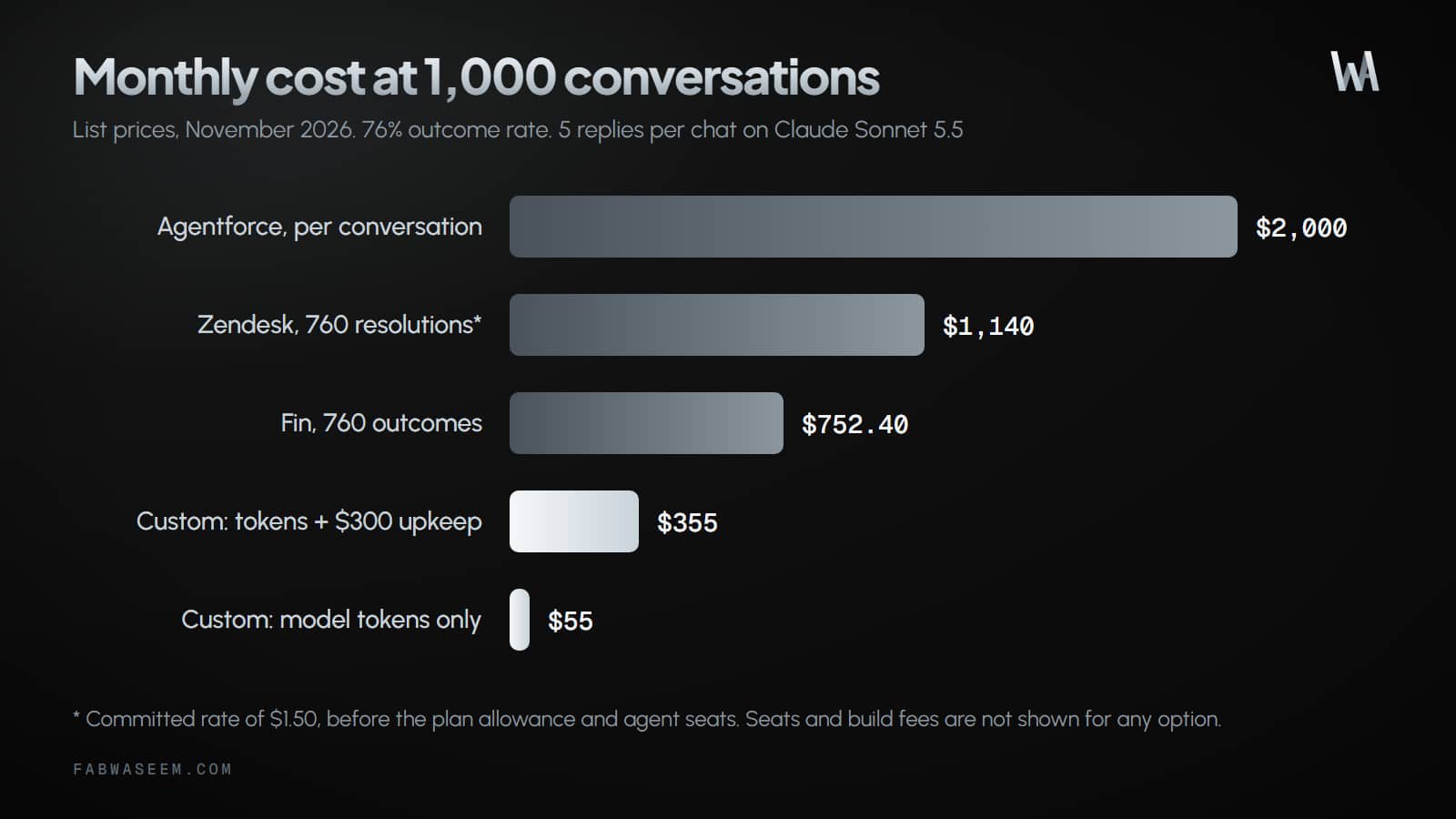
Hosted AI agents mostly bill by what the agent handles. Published prices include $0.99 per outcome for Fin, $1.50 to $2.00 per automated resolution at Zendesk, and $2 per conversation for Salesforce Agentforce. Your bill therefore grows with your volume.
The 76% figure is the average resolution rate Fin publishes for itself. It is applied to Zendesk here only to keep the volumes equal. Your own rate depends on how good your help content is and how many questions need a person.
Read the definition of the billable unit before you compare. Fin counts some handoffs as outcomes when its workflow completes them. Zendesk's current resolution model charges your allowance only for verified resolutions. Two products with a similar sticker price can produce different bills from the same inbox.
How much does a custom AI agent cost to run each month?#
A custom AI agent's model bill is usually its smallest line. Using 5 replies per conversation, 4,000 input tokens and 300 output tokens per reply, 1,000 conversations cost about $2.75 on a small model and $55 on a mid-size model such as Claude Sonnet 5.5, before hosting and upkeep.
A token is a small chunk of text. Anthropic's glossary puts one token at about 3.5 English characters on its earlier models, and says Claude 4.7 and later produce about 30% more tokens for the same text. On a current model, 4,000 input tokens is therefore roughly 11,000 characters: your instructions, a few help articles and the chat so far. The reply and token counts are assumptions, not an industry average.
Prices are standard list rates from Anthropic, OpenAI and Google. Haiku 5.5's rate applies to prompts up to 100,000 tokens. Gemini 3.8 Flash doubles to $1.50 / $7.50 on January 1, 2027, which turns the $20.63 into $41.25.
Two discounts can lower the bill:
- Prompt caching reuses the repeated part of each request. Assume 3,000 of the 4,000 input tokens never change, replies arrive within the 5-minute cache lifetime and each conversation pays for one cache write. The Sonnet 5.5 figure then drops from $55.00 to $33.70 per 1,000 conversations.
- Batch processing is half price at Anthropic, but it is for work that can wait, such as nightly email sorting, not live chat.
A smaller model for simple questions, shorter instructions and a cap on replies lower it further. Web search is billed separately. Anthropic charges $10 per 1,000 searches plus the tokens, so an agent that searches once on each of 5 replies adds $50 per 1,000 conversations in search fees, before the extra tokens.
Hosting and automation tools#
A small agent needs somewhere to run. As one reference point, Hetzner lists its CPX22 cloud server (2 vCPU, 4 GB) at €19.99 a month in Germany before VAT. If the agent is built on an automation tool, count its meter too:
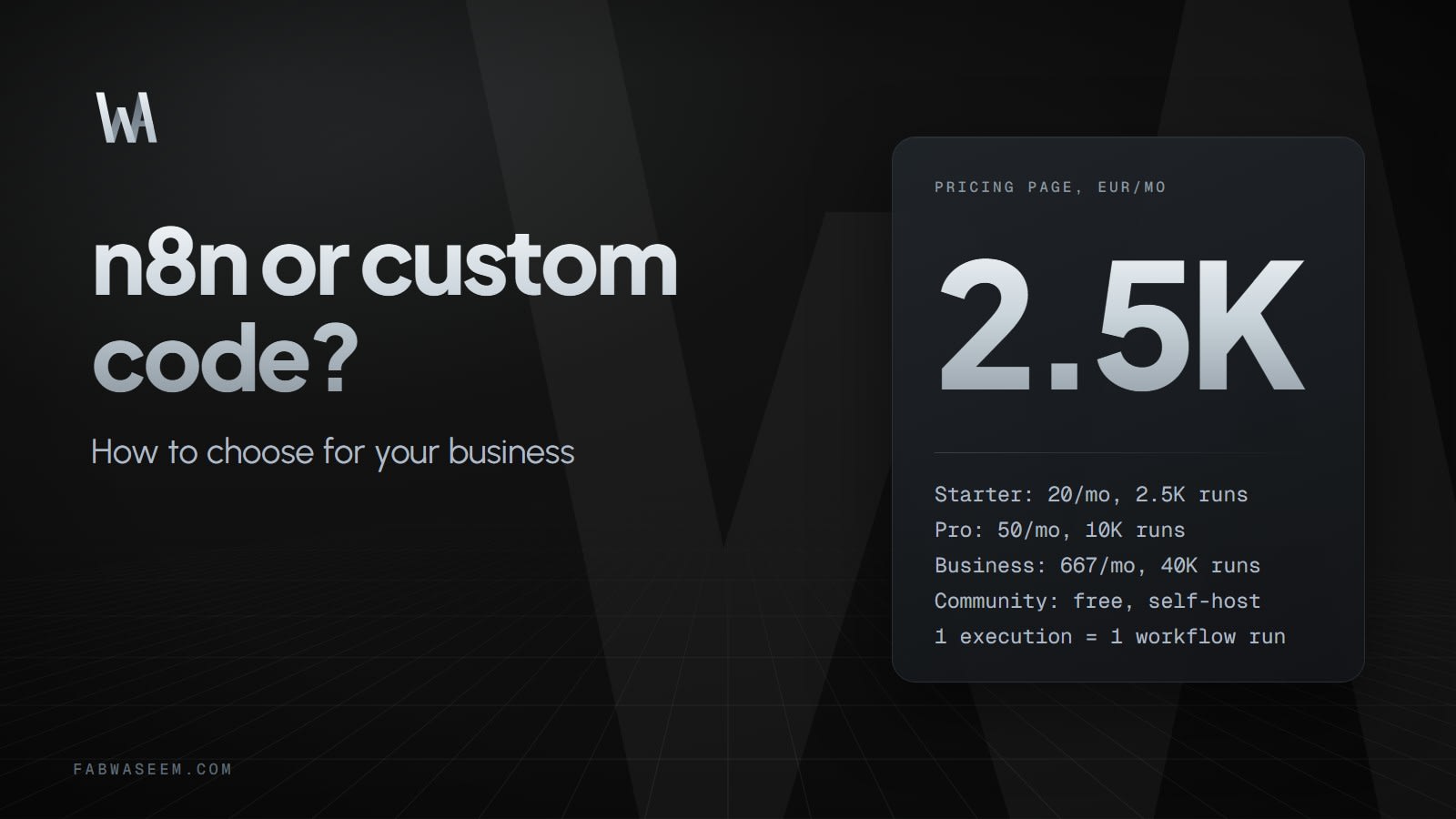
- n8n Cloud Starter is €20 a month billed annually for 2,500 workflow executions. An execution is one run of a whole workflow. If each customer message triggers a run, 1,000 conversations of 5 messages make 5,000 runs, which needs the €50 Pro plan.
- Zapier Pro starts at $19.99 a month billed annually for 750 tasks. It counts each successful action, so a multi-step reply uses several tasks.
The n8n vs custom code comparison covers which of the two fits your process.
Is a custom AI agent cheaper than a hosted one?#
It depends on volume. Against Fin, with $300 of monthly upkeep, hosted is cheaper at 200 conversations, while custom costs less per month at 1,000 and 5,000, before the build fee. The most you should spend on a build to break even within a year is 12 times the monthly saving.
The table uses Fin as the hosted price, Claude Sonnet 5.5 for the custom agent, and $300 a month for hosting, tools and maintenance. The $300 is a placeholder to replace with a real quote.
Upkeep moves the answer far more than the model does. At 1,000 conversations, upkeep of $150 raises the build budget to $6,569, and upkeep of $600 shrinks it to $1,169. Switching from Sonnet 5.5 to Haiku 5.5 changes it by only $627.
The comparison assumes both agents resolve the same share of conversations. Staff time on the rest is a real cost: at 76%, 240 of 1,000 chats reach a person, and at an assumed 5 minutes each and $25 an hour that is 20 hours, or $500 a month. A custom agent that resolves fewer adds to that figure. The table also ignores what the hosted product includes, such as a shared inbox and reporting.
To run your own numbers, save this as agent-cost.mjs, edit the values at the top, and run node agent-cost.mjs 1000 with your monthly conversation count.
// agent-cost.mjs
const conversations = Number(process.argv[2] ?? 1000); // per month
const repliesPerConversation = 5;
const inputTokensPerReply = 4000;
const outputTokensPerReply = 300;

const inputPrice = 2; // USD per 1M input tokens (Claude Sonnet 5.5)
const outputPrice = 10; // USD per 1M output tokens
const upkeepPerMonth = 300; // hosting, tools, maintenance: use your quote

const resolutionRate = 0.76; // share the hosted agent resolves
const pricePerOutcome = 0.99; // Fin
const platformMinimum = 49; // Fin on an existing helpdesk

const replies = conversations * repliesPerConversation;
const tokens =
  (replies * inputTokensPerReply * inputPrice +
    replies * outputTokensPerReply * outputPrice) /
  1e6;
const hosted = Math.max(
  platformMinimum,
  conversations * resolutionRate * pricePerOutcome,
);
const saving = hosted - tokens - upkeepPerMonth;

console.log(`Hosted: $${hosted.toFixed(2)} per month`);
console.log(`Custom: $${(tokens + upkeepPerMonth).toFixed(2)} per month`);
console.log(
  saving > 0
    ? `Build budget to break even in a year: $${Math.round(saving * 12)}`
    : "A custom build does not pay back at this volume",
);
How much does it cost to build a custom AI agent?#
There is no reliable list price for a build, and published agency ranges barely agree. MindPath puts a basic custom agent at $10,000 to $25,000. The Crunch shows $15,000 to $200,000 for agency builds in one table, and $1,500 to $5,000 for a single-purpose agent elsewhere on the same page. Scope decides the number, so ask for a quote against a written list of tasks.
These choices move a quote the most:
- Answering or acting. Reading help articles is simpler than issuing refunds or editing orders. Actions need permissions, logs and human approval before risky steps.
- Number of systems. Each shop, CRM, calendar or accounting tool is a separate integration to build and test.
- State of your content. Scattered or outdated documents need cleanup before retrieval over your own documents gives good answers.
- Channels and languages. Website chat, WhatsApp and email behave differently and each needs testing.
- Proof it works. Testing against real past questions takes time and is the part most worth paying for.
Ask every developer or agency these before you sign:
- Which tasks are included, and what happens when the agent cannot finish one?
- What is the estimated monthly running cost at my volume, and which assumptions produce it?
- Who owns the code, the accounts and the API keys?
- What does monthly maintenance cover, and what is billed extra?
- How will we measure the resolution rate in the first month?
How do you stop a surprise AI bill?#
Set a hard spending limit with your model provider before launch, and decide what the agent does when it hits that limit. An alert tells you money is being spent. A hard limit stops requests, so customers need a fallback, such as a handover to a person.
- Anthropic: set a monthly spend limit in the Console. Once your own limit is reached, API requests fail with an HTTP 400
invalid_request_error. - OpenAI: open the spend limit settings, enter a monthly limit and turn on "Enforce a hard limit". Without that switch it is not a cap, and spend alerts alone do not stop anything. Blocked requests return a 429 error, and OpenAI notes that recorded spend can slightly exceed the amount.
- Hosted products: ask what happens past your quota or committed volume, and whether overage is billed automatically.
Also cap replies per conversation and log token use from day one. Retries add up: 20% more model calls turns the $55 into $66, and a loop that keeps retrying a failed step can cost far more.
Which option should you pick?#
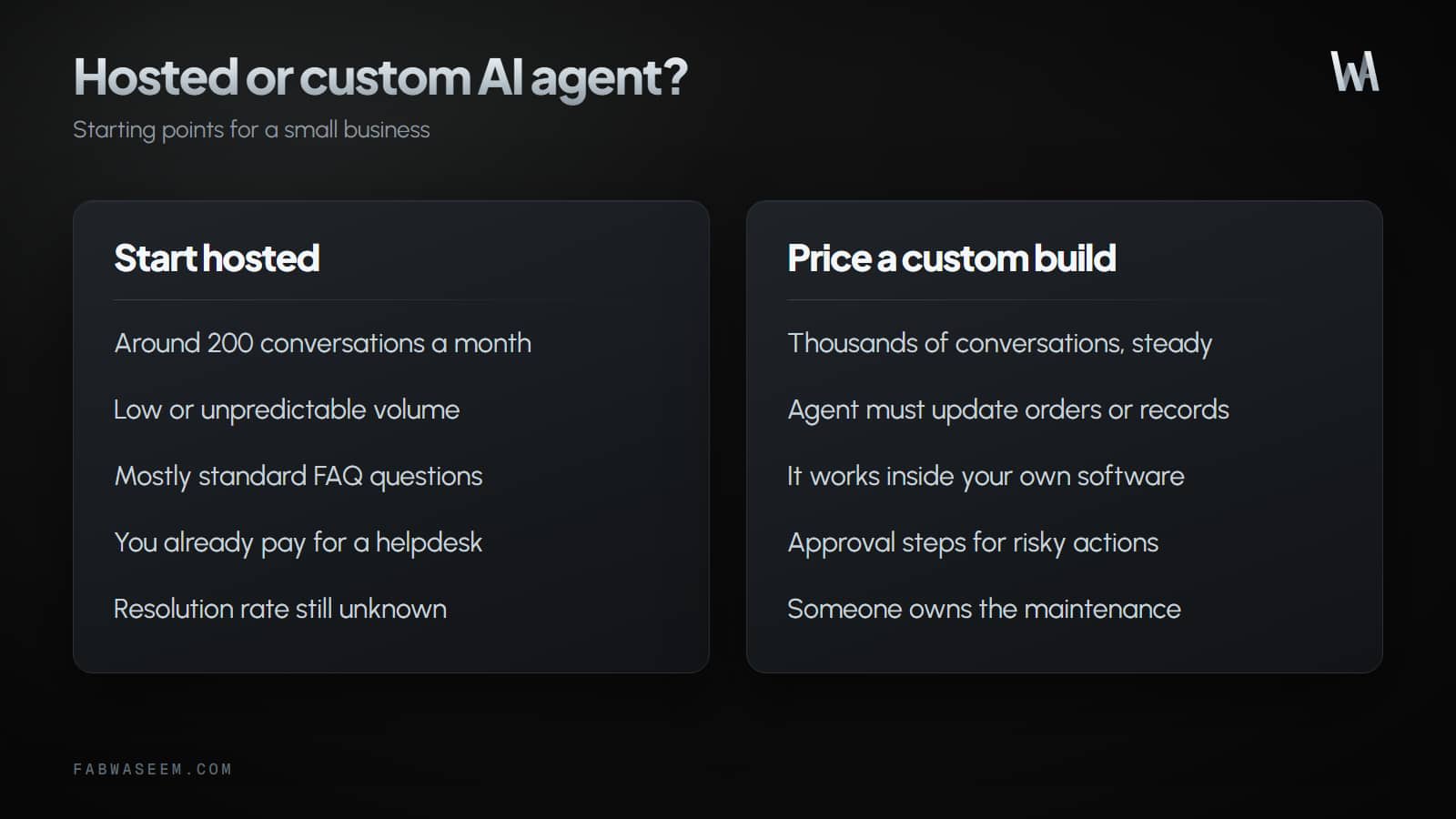
Pick a hosted agent if you have low or unpredictable volume and standard support questions. Pick a custom agent if volume is high and steady, the agent must act inside your own systems, and someone is responsible for maintaining it.
If the numbers point to a custom build, the AI automation service scopes it against your own volume, and the guide to LLM apps in production shows what a reliable one involves.
Key takeaways#
- Count five costs: build, usage, software, upkeep and human handover.
- Hosted agents charge per outcome, resolution or conversation, so the bill scales with volume.
- Model tokens for 1,000 support conversations range from about $3 to $110 under the assumptions above.
- Maintenance usually decides whether a custom agent pays off, more than the model choice.
- At 200 conversations a month, a $0.99-per-outcome product beats a custom agent with $300 upkeep.
- Turn on a hard spending limit and plan the human fallback before launch.
Questions
Share this guide
Comments
No comments yet. Questions, corrections and your own results are all welcome.
Be kind and stay on topic. No name needed: leave it blank and you post under an anonymous name that stays yours. Links get
nofollow; spam is removed. Your email is never shown and is only used for reply notifications you ask for. Privacy